

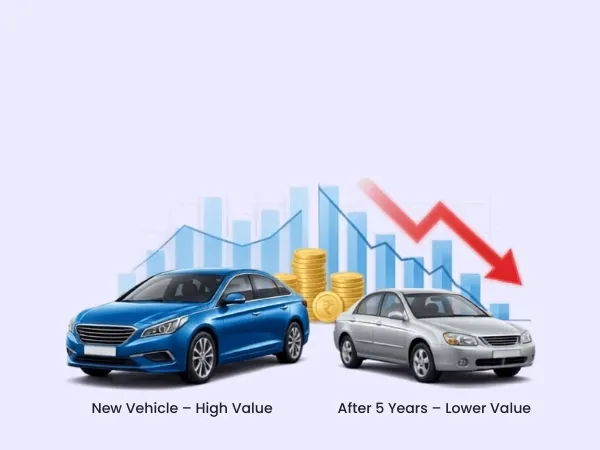
Vehicle depreciation rate is the percentage reduction in a car’s value over time due to usage, age, and wear, as recognized under the Income Tax Act, 1961.
It matters because it directly impacts tax deductions (for businesses), resale value, and financial planning.
Under Section 32, depreciation is allowed only for business or professional use, not personal use.
Why Vehicle Depreciation Matters?
- Reduces taxable income for businesses
- Determines resale value decline over time
- Impacts loan planning and asset valuation
How Depreciation Is Calculated?
- Method: Written Down Value (WDV)
- System: Block of Assets classification
In essence: depreciation is both a cost factor and a tax-saving mechanism.
How to Calculate Car Depreciation Rate?
Car depreciation in India is calculated using the Written Down Value (WDV) method, where a fixed percentage is applied to the reduced value each year.
This ensures depreciation decreases annually instead of remaining constant.
It is the prescribed method under the Income Tax Act.
Formula
- Depreciation = Opening WDV × Applicable Rate
- Closing WDV = Opening Value – Depreciation
Example (Business Use Car)
- Purchase price = ₹10,00,000
- Depreciation rate = 15%
Year 1
- Depreciation = ₹1,50,000
- Closing value = ₹8,50,000
Year 2
- Depreciation = ₹1,27,500
- Closing value = ₹7,22,500
Key Points
- Depreciation reduces each year
- Applies only if the vehicle is used for business/profession
- Must be recorded under a Block of Assets
Vehicle Depreciation Rate Chart 2025-26 (Income Tax Act)
Vehicle depreciation rates in India are defined under the Income Tax Act, 1961 and vary based on usage and conditions.
The key distinction is whether the vehicle is used in the business of running it on hire.
Below is the accurate, compliance-aligned chart.
Depreciation Rate Chart
Asset Type | Depreciation Rate | Applicable Use |
|---|---|---|
Motor Cars (Business use, not on hire) | 15% | Business/profession |
Motor Cars (Used on hire) | 30% | Taxi, rental |
Motor Buses / Trucks / Lorries | 30% | Transport/logistics or hire business |
Electric Vehicles | 15% (unless higher rate notified) | Personal & Business use |
Important Notes
- Rates applied using Written Down Value (WDV) method
- 30% rate applies only when used in transport/hire business
- If used for less than 180 days → only 50% depreciation allowed
- Personal-use vehicles → Not eligible
- Assets grouped under Block of Assets
Car Depreciation Rate India: Passenger Cars vs Commercial Vehicles
Car depreciation rates in India differ based on whether the vehicle is used for business purposes or in the business of running it on hire.
Under the Income Tax Act, 1961, higher depreciation (30%) is allowed only when the “used on hire” condition is satisfied.
This distinction directly determines the level of tax deduction available.
Factor | Passenger Cars | Commercial Vehicles (Used on Hire) |
|---|---|---|
Depreciation Rate | 15% | 30% |
Usage Condition | Business use (not on hire) | Must be used in business of running on hire |
Tax Benefit | Standard deduction | Higher deduction under Section 32 |
Eligibility | Ownership + business use | Ownership + revenue-generating hire use |
Documentation | Books of accounts, usage records | Hire invoices, permits, revenue proof |
Mini Case
- Company-owned car used by director → 15% depreciation
- Taxi used for passenger service → 30% depreciation
Key Insights
- Simply labeling a vehicle as “commercial” does not qualify it for 30% depreciation.
- The “used on hire” condition is legally mandatory.
- If the vehicle is used for less than 180 days, only 50% of depreciation is allowed in that year.
- In case of mixed use (personal + business), depreciation must be restricted proportionately.
Steps To Calculate Depreciation Value of a Car?
Car depreciation is calculated using the Written Down Value (WDV) method under Section 32, where the applicable rate is applied to the opening WDV each year within a Block of Assets.
The rate depends on usage, and first-year claims may be restricted by the 180-day rule.
Follow these steps to compute it accurately.
Step-by-Step Process
1. Determine Actual Cost (Capitalised Value)
- Include:
- purchase price
- registration & road tax
- delivery/handling, accessories (if capitalised)
- non-recoverable GST (if applicable)
- Exclude:
- recurring insurance, fuel, maintenance
2. Clarify Usage Correctly:
- Business use (not on hire) → 15%
- Used in the business of running it on hire → 30%
3. Apply Half-Year Rule (Year of Purchase)
- Used ≥ 180 days → full rate
- Used < 180 days → 50% of the rate
- (15% → 7.5%, 30% → 15%)
4. Compute Depreciation (WDV Method)
- Depreciation = Opening WDV × Applicable Rate
- Year 1 opening WDV = actual cost
- Subsequent years: use closing WDV of prior year
5. Adjust for Mixed Use (If Any)
- If partly personal → claim only business-use proportion
6. Update Closing WDV
- Closing WDV = Opening WDV − Depreciation
- Carry forward to next year within the Block of Assets
Example A (Used ≥ 180 days, not on hire)
- Cost = ₹8,00,000
- Rate = 15%
Year 1
- Depreciation = 8,00,000 × 15% = ₹1,20,000
- Closing WDV = ₹6,80,000
Year 2
- Depreciation = 6,80,000 × 15% = ₹1,02,000
- Closing WDV = ₹5,78,000
Example B (Used < 180 days, not on hire)
- Cost = ₹8,00,000
- Rate = 15% → 7.5% in Year 1
Year 1
- Depreciation = 8,00,000 × 7.5% = ₹60,000
- Closing WDV = ₹7,40,000
Year 2
- Depreciation = 7,40,000 × 15% = ₹1,11,000
- Closing WDV = ₹6,29,000
Practical Compliance Tips
- Maintain:
- asset register (Block of Assets)
- usage logbook (for business vs personal split)
- hire invoices/permits (to justify 30% rate)
Note: Ensure entries align with books for tax audit.
Depreciation on Car India: Who Can Claim, Rules & Income Tax Benefits
Depreciation on cars in India can be claimed only by taxpayers who own and use the vehicle for the purposes of business or profession under the Income Tax Act, 1961.
It is not allowed for purely personal vehicles.
The deduction reduces taxable income in accordance with Section 32.
Who Can Claim?
- Business owners (sole proprietors, firms)
- Professionals (doctors, consultants, freelancers)
- Companies and LLPs
Key Rules
Asset must be:
- owned (legal or beneficial ownership required)
- used for business/profession
- put to use during the financial year
Depreciation is computed using:
- Written Down Value (WDV) method
- Block of Assets system
If used for less than 180 days:
- only 50% of depreciation is allowed
Tax Saving Example
- Business income = ₹12,00,000
- Depreciation (eligible claim) = ₹1,80,000
- Taxable income = ₹10,20,000
Note: Full deduction applies only if:
- vehicle is fully used for business.
- no personal usage involved.
Financing Context
Businesses often structure vehicle purchases through NBFCs like SK Finance, aligning repayment schedules with depreciation benefits for better cash flow planning, without affecting eligibility under tax rules.
Important Clarification
- Personal use → No depreciation allowed
- Mixed use → Only proportionate depreciation allowed
- Allocation must be:
- reasonable
- documented
- defensible during tax assessment
Car Depreciation Per Year - Real-Life Impact on Resale & Tax Savings
Car depreciation per year has two separate financial impacts:
(1) reduction in the vehicle’s market resale value, and
(2) reduction in taxable income when depreciation is claimed under the Income Tax Act, 1961.
These two are not calculated the same way.
Tax depreciation follows fixed rules under Section 32 using the Written Down Value (WDV) method, while market depreciation depends on real-world factors like usage, brand, and demand.
Market Depreciation Trend (Indicative, Not Fixed)
In real-world resale markets, cars lose value faster in the initial years and then stabilize gradually.
- Year 1: 15% to 25% reduction
- Year 2–3: 10% to 15% reduction per year
- After Year 5: depreciation slows significantly
These figures are indicative averages, not legally fixed rates.
Actual resale value depends on:
- vehicle brand and segment
- total kilometers driven
- maintenance and service history
- fuel type and market demand
Real-Life Example (Market Value Impact)
Purchase price: ₹12,00,000
After 3 years:
- Year 1 (approx. 20% drop): ₹9,60,000
- Year 2 (approx. 12% drop): ₹8,45,000
- Year 3 (approx. 12% drop): ₹7,43,000
Approximate resale value: ₹7–7.5 lakh
This illustrates how maximum value erosion happens in early years, even if the car is well maintained.
Tax Perspective (As per Section 32)
Under the Income Tax Act:
Depreciation is calculated using:
- Written Down Value (WDV) method
Standard Rate:
- 15% (if not used on hire)
- 30% (if used in the business of running on hire)
Key Conditions:
- Vehicle must be:
- owned (legal or beneficial ownership)
- used for business or professional purposes
- If used for less than 180 days in a year:
- only 50% of depreciation is allowed
- If used for both personal and business purposes:
- only proportionate depreciation can be claimed
Important: Tax depreciation is predefined by law and does NOT depend on resale value.
Strategic Insight (Why 3–5 Years Matters)
Selling a car between 3 to 5 years is often financially efficient because:
- Initial heavy depreciation has already occurred
- Resale value is still relatively strong
- Repair and maintenance costs start increasing after this period
- Tax benefits from depreciation have already been utilized significantly
This creates a balance between:
- value retained
- cost of ownership
- tax efficiency (for business users)
Practical Use Case (Financial Planning Angle)
When a vehicle is financed:
- Buyers often align:
- loan tenure
- expected depreciation cycle
For example:
- A 5-year loan aligned with a 3–5 year resale strategy helps:
- avoid holding a low-value asset
- manage overall cost of ownership
NBFCs such as SK Finance are commonly used in such cases, where borrowers evaluate repayment schedules alongside depreciation impact to maintain financial efficiency.
Choosing the right car loan tenure also plays an important role, as a longer repayment period can lower monthly EMI amounts, while a shorter tenure may help reduce the overall interest burden.

Depreciation Reimbursement Meaning Explained
Depreciation reimbursement refers to compensation provided by an employer to an employee for the reduction in value of a personal vehicle used for official work.
While the reimbursement policy is defined by the employer, its tax treatment is governed under the Income Tax Act, 1961.
It is different from depreciation claimed under Section 32, which applies only to business-owned assets.
How It Works
- Employee uses a personally owned vehicle for official duties
- Employer reimburses expenses such as:
- fuel
- maintenance
- a notional depreciation component (as per company policy)
Important:
- There is no fixed legal formula for depreciation reimbursement.
- Calculation method varies across organizations.
Example (Illustrative Only)
- Car value = ₹8,00,000
- Assumed depreciation (for internal calculation) = ₹1,20,000
- Official usage = 50%
Reimbursement for depreciation component ≈ ₹60,000
Note:
- This is not a statutory depreciation calculation.
- Actual reimbursement depends on employer policy.
Tax Treatment (Critical)
Reimbursement may be:
- fully taxable, or
- partially tax-efficient, depending on structure
Factors affecting taxability:
- documentation of official usage
- employer’s salary structure
- supporting bills and declarations
Without proper records:
- reimbursement may be treated as taxable salary
Key Difference
Tax depreciation (Section 32)
- claimed by business owners
- reduces taxable income
- calculated using WDV method
Depreciation reimbursement
- provided by employer
- part of compensation structure
- taxability depends on documentation and policy
Conclusion About Vehicle Depreciation Rate in India
Vehicle depreciation rate in India determines how a car’s value is written off for tax purposes under the Income Tax Act, 1961 in accordance with Section 32.
It applies only when the vehicle is owned (wholly or partly) and used for the purposes of business or profession, and is calculated on the Written Down Value (WDV) within a Block of Assets.
Final conclusion: Vehicle depreciation is a statutory deduction mechanism, not an estimate, and must strictly follow legal conditions to be valid.
Disclaimer
The information provided in this blog is for general awareness and informational purposes only. For complete details regarding our products and services, please visit the nearest branch.